
*Sigh*
The piece Liszt refused to name — and why I'm obsessed with it

Vesuvius and Etna were in fire, and the trumpet of judgement sounded from the mountains of Greece, where the old gods died. Tones I knew not, tones I have no words for, spoke of the Orient, the land of imagination, the poet’s other fatherland!
When Liszt had finished playing flowers rained down around him, young gorgeous girls, and old ladies who had once been gorgeous, each cast her bouquet;
he had cast thousands of tone-bouquets into their hearts and heads.
So writes H.C. Andersen about Liszt in 1842, likely referring to seeing him play for the first time in Hamburg in 1840. Lisztomania was running rampant. From 1838 to 1847 Liszt toured Europe playing from east to west many times — literally inventing the piano recital as it is today.
In September 1847, with Lisztomania at its highest, Franz Liszt played his last ever paid concert in Elizabetgrad, now in central Ukraine. Like when Beatles were just gone from one day to the next (without the shooting obviously).
Then he moved to the small German city of Weimar, took up a court position, and settled into a quieter life with his new companion, Princess Carolyne zu Sayn-Wittgenstein — a Polish noblewoman he had met just months earlier in Kiev.
It was during this period — at the peak of his recital career and in those first months of his new settled life in Weimar — that he completed three concert etudes, one of them Un Sospiro: Italian for “A Sigh.” The title fits the biographical moment almost too well. After a decade of Lisztomania, of touring from the Pyrenees to Ukraine, of audiences fainting and flowers raining down — this was the exhale.
A name he never used
Most sources agree however, that Liszt never actually named this piece “Un Sospiro.” The name was given to it by the French edition of the sheet music shortly after the first edition came out. Liszt himself referred to the piece by its key: D-flat major. What makes this stranger still is that he apparently knew about the subtitle — and simply ignored it. For the rest of his life he refused to use it.
He did, however, keep the piece in his personal repertoire until his final years. For a man who wrote over 700 works, that kind of quiet loyalty to one piece says something.
The piece was dedicated to his uncle Eduard Liszt, who managed Franz’s business affairs for over thirty years. There is something quietly charming about the most poetic, atmospheric piece in the set being dedicated to the man who dealt with the contracts while Liszt dealt with the volcanoes and sighs.
This interesting dedication is even more exacerbated by the fact that at the time, this piece was harmonically radical. Most piano music of the era followed strict rules about which keys you could move between, favouring keys that shared common notes — like C major to G major. But in Un Sospiro, Liszt shifts between D-flat, A, F and C-sharp: keys that share almost nothing. This shouldn’t work theoretically, but it does. It creates a floating, rootless quality — you can’t quite tell where home is. This harmonic language went on to become a foundation of Impressionism; Debussy was doing something spiritually similar thirty years later.
The piece was originally published as part of a set of three Concert Etudes — that was the actual title. While they are etudes — pieces designed to train a specific technique — they were absolutely intended for concert performance too.
The technique the etude trains is the crossing of hands, with the melody shifting between them. The latter feature, a melody that shifts between hands, is a feature I know well from Liebesträume No. 3, which I covered earlier.
What Liszt was actually asking pianists to do
In Un Sospiro, Liszt takes this idea to the extreme. Not only does the melody shift hands with every other note, the hands also physically cross to reach the notes being played. And as with all Liszt, this happens at lightning speed.
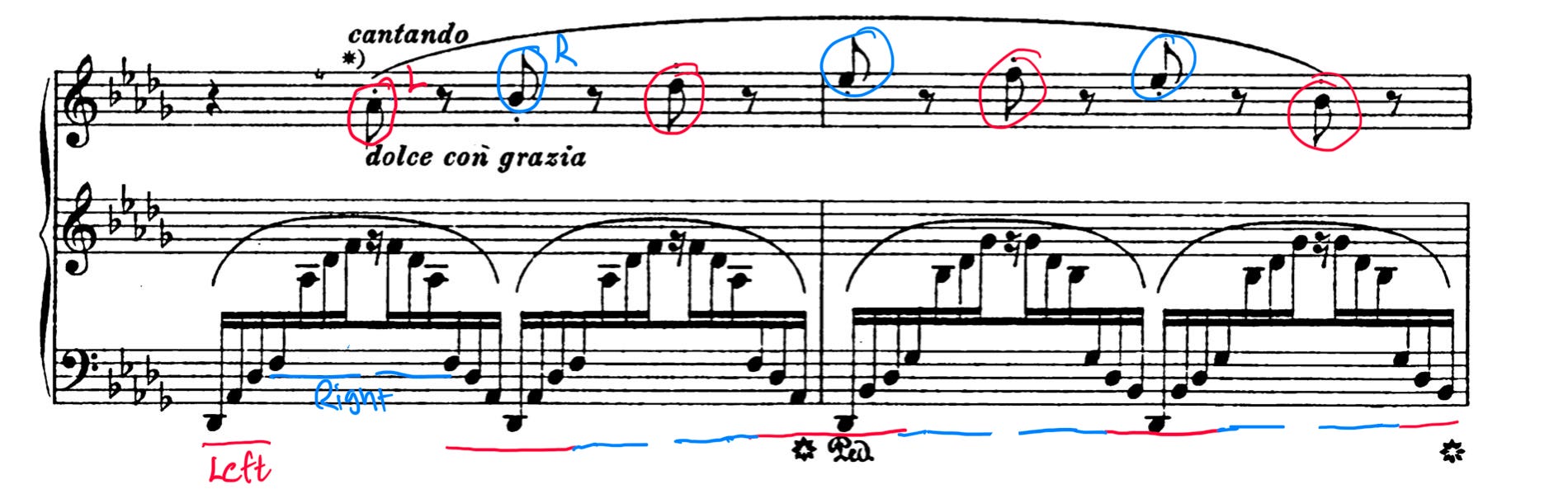
The image above shows why this is so demanding. The first few notes are played by the left hand, the next few by the right, and the melody line at the top alternates hands with each note — right, then left, then right. So here you play first the red part with the left, then blue part with the right and while the left hand plays, the right hand moves over the left hand and hits the Ab before rushing back to hit the same notes it just played.
And this only gets more complex as the piece continues. The arpeggios roll fast, giving the piece its wonderful floating, almost rainbow-like texture. Back in the mid-19th century pianists were known to sit quite still when performing. With this piece that’s impossible. You lean left and right in a rocking motion to reach the notes, fast, while simultaneously managing which notes to play, the speed, and the dynamic of each one..
How it started, how it’s going
This is one of my favourite Liszt pieces — and yes I say that with all pieces I’ve talked about here so far #lisztfanboy. When I first heard it about a year ago it initially registered something in me. The floating arpeggios, the beautiful melody, that Ab note that I’ve talked about earlier.
At the time I was thinking that playing this piece would be many years away, yet here we are one year later.
And I’m kind of happy with the progress so far. I’ve started on this on March 16, with a one week break because of the World Piano Day Challenge and then I’ve been gone for 4 days during Easter, meaning that I’ve went from this:
… to this:
… in roughly 11 days. Which just happen to be the exact bar number that I’m at right now. So that’s 1 day per bar. That’s kind of ok.
Train the cross-hand pattern
The key to learning this seems to be to learn the arpeggiated cross-hand pattern very well. So when I first thought about how to play this I thought about playing the opening 2 bars without doing the cross hand move. This is actually possible and based on some basic research this seems to be how most people prefer to play it.
I however, prefer to play it with the cross hand move as much as possible as this is first of all the pattern that Liszt intended to train in this etude, but also the hardest part of it. So I figured if I increased the reps of doing this move then the rest of the piece will be easier to learn. Still too early to tell if that will pay off or not.
Here’s a short video where I explain this idea.
The issue with doing it this way is to make sure that the melody is played at the right accentuation based on whether the note is part of the right hand arpeggio or the melody. As you can probably hear in the videos above I still have some work to do in playing the melody and arpeggios at a more even volume where the melody still rings out.
The pièce de résistance
Liszt named this piece by its key. Someone else called it a sigh, and he never bothered to correct them. Maybe because it fit.
I’m eleven bars in and the melody is starting to sing above the arpeggios.
This is the pièce de résistance of Year 1. I expect it will take 6-9 months to reach recital level — but when it does, it will be in the first house concert I’m planning near the end of the year. I can’t stop thinking about the parallel: Liszt completed this piece at the beginning of a new chapter, having just walked away from the life of a 1840s rockstar and settled into another. I wouldn’t say I’m settling into another but I’m certainly switching gears.
That’s the thing about a sigh. You don’t plan it. It just arrives when something finally releases.
Bar 12 is an easy one. It’s just the repetition of the starting pattern, so I will see you at bar 13 which looks even more insane…